

Day in the life7 min
Handover to handover on a busy acute ward: the rhythm of the shift, the interruptions, the paperwork, and the moments that make people stay.
By Grace Donnelly, Staff Writer — Grace writes profession explainers and day-in-the-life features for Healthcare Job Search.

Ward nursing is the job most people picture when they think of nursing, and it is also the one most often described in terms that miss what it actually involves. Adverts talk about delivering high-quality patient care and working within a multidisciplinary team. What they do not convey is the constant reprioritising, the volume of small decisions, and the way a shift can be entirely reshaped by one deteriorating patient at eleven in the morning. To make it concrete, this article follows a composite long day on a general medical ward. The nurse described, Rachel, is not a real person; she is an illustrative composite drawn from common patterns.
Rachel arrives about fifteen minutes early. This is not officially required and almost everyone does it. She puts her bag in the locker, checks the off-duty on the wall for the coming fortnight, and finds out from the board how many patients are on the ward, how many staff are on, and whether anyone has called in sick.
Today there are two healthcare assistants for twenty-eight beds and four registered nurses including her. That is workable. Yesterday there were three nurses, and she has heard about it already from the night staff.
Handover runs about twenty minutes for the whole ward, then the nurses take bay handovers individually. Rachel picks up a bay of eight, which is a lot but not unusual.
She writes as she listens. Bed nine is new overnight, admitted with a chest infection, on intravenous antibiotics, and has a history that suggests she will need careful fluid management. Bed eleven is medically fit for discharge but waiting on a package of care, which means he has been fit for four days. Bed thirteen has been unsettled overnight, is confused, and pulled out a cannula at four in the morning. Bed fourteen is for theatre later. Bed fifteen is nearing the end of life and the family have been in overnight.
By the end of handover she has a list, a rough plan, and three things she already knows are going to be difficult.
The first thing she does is walk round and physically look at all eight patients. This is not universal practice but the nurses who do it swear by it, because the difference between how someone was described at handover and how they actually look is the most useful clinical information available.
Bed thirteen is agitated and trying to climb over the rails. Bed fifteen's family are still there and look exhausted. Bed nine's observations have already been done by the healthcare assistant and her respiratory rate is up from the night.
Rachel makes a decision that shapes the morning: bed nine gets escalated now rather than at the ward round, and she asks the healthcare assistant to stay near bed thirteen while she sorts out the cannula.
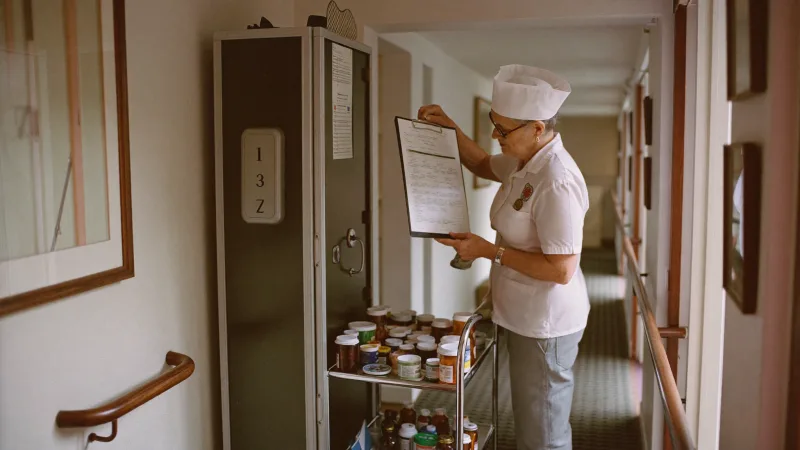
The morning drug round is meant to take an hour and rarely does. It is interrupted by a doctor wanting to discuss bed eleven, a relative asking about discharge, a phone call from radiology, and a patient who needs the toilet urgently and cannot wait.
Interruption during medication administration is a well-recognised source of error, and most wards now have some version of a do-not-disturb protocol, tabards or designated quiet periods. How well it is respected varies. Rachel works through it, checking each drug against the chart, checking allergies, checking the patient's identity band each time, and quietly re-checking the one that does not look right.
Two drugs are unavailable and have to be chased from pharmacy. One patient refuses their medication, which requires a conversation about why rather than a note that it was declined.
The consultant ward round arrives mid-morning with a registrar, a junior doctor and a pharmacist. Rachel joins it for her bay, which means leaving everything else for forty minutes.
This is the part of the day where being present matters most. Decisions are made quickly, and the nurse who knows the patient is often the person who says the thing that changes the plan: that the patient was confused overnight, that the family have concerns, that the cannula has tissued, that he has not actually eaten in two days despite what the chart says.
Bed nine's antibiotics are escalated and a chest X-ray is requested. Bed fifteen's treatment is formally changed to comfort-focused care, and Rachel is asked to speak with the family, which she will do properly rather than in a corridor.
The afternoon is admissions, discharges and everything that was deferred in the morning.
Bed eleven's package of care is confirmed, which sets off two hours of work: discharge summary chased, medications to take home ordered from pharmacy, transport booked, family called, community team informed, equipment confirmed. Discharges are frequently described as paperwork. They are actually coordination, and a discharge that goes wrong at four in the afternoon becomes an overnight stay.
Bed fourteen goes to theatre and comes back needing closer observation. A new admission arrives from the emergency department, needing a full assessment, a set of observations, a care plan and a family conversation.
Rachel has not sat down. She has drunk one cup of tea, cold.
At some point in the afternoon she sits down with bed fifteen's family in the relatives' room. It takes thirty-five minutes and it is the most important thing she does all day.
This is the part of the job that never appears in a job description in any recognisable form. It requires knowing what has actually been said by the medical team, being honest without removing hope people are entitled to, answering the question underneath the question, and being able to sit with distress without rushing to fix it.
She comes out, washes her face, and goes back to the drug round.
Records are updated through the day in principle and in large chunks at the end in practice. Risk assessments, fluid balance, nutritional scores, pressure area care, care plan updates, incident forms if anything happened.
Rachel finishes her notes after her shift technically ended. Almost everyone does. It is one of the more corrosive features of the job, and it is why the wards where documentation is genuinely built into the day are noticeably better places to work.
She hands over to the late team, or the night team if it is a long day. Good handover is a skill: enough detail to be safe, brief enough to be absorbed, with the two or three things that actually matter flagged clearly rather than buried in a chronological account.
Then the walk to the car, and the twenty minutes at home before she stops thinking about whether she chased that X-ray.
Beyond the clinical skills, ward nursing depends on a set of things that are harder to teach: prioritisation under constant interruption, the confidence to escalate when something is not right and you cannot yet say why, communication with people at the worst point in their lives, and the ability to hold eight sets of competing needs in your head at once.
It is physically demanding, and it is cognitively demanding in a way people underestimate. The tiredness at the end of a long day is not only from being on your feet.
A surgical ward runs to a different rhythm than a medical one, with more predictable throughput and more post-operative observation. Care of the elderly involves more complexity and more discharge planning. Specialist wards have narrower clinical focus and often better staffing. Community hospitals are quieter and more autonomous. Night shifts are a different job again, with fewer staff, no ward round, and more independent decision-making.
Ward nursing is the foundation for most of nursing. From here people move into specialist practice, advanced practice, education, management, community and primary care, research, and a great many other things. Two or three years on a busy ward remains one of the best clinical groundings available, which is why so many people who no longer do it are glad they did.
This article is general information, not legal, immigration or medical advice. Always confirm current requirements with the relevant official body.
Where to look next
Keep reading
We would like to set one optional cookie that recognises your browser when you come back, so we can tell returning visitors from new ones. It stays off unless you say yes, and you can change your mind at any time. Cookies that keep you signed in are always on. Read our cookie policy