Day in the life7 min
Twelve hours on an ambulance: unpredictable calls, long handovers, quick decisions in other people's front rooms, and the paperwork nobody warns you about.
By Grace Donnelly, Staff Writer — Grace writes profession explainers and day-in-the-life features for Healthcare Job Search.
Paramedic work is one of the most visible healthcare jobs and one of the most misrepresented. Television gives the impression of continuous emergency; the reality includes a great deal of assessment, decision-making about who does not need hospital, long waits at emergency department doors, and a substantial amount of care for people whose problem is as much social as medical. To make it concrete, this article follows a composite twelve-hour day shift on a double-crewed ambulance. The paramedic described, Tom, is not a real person; he is an illustrative composite drawn from common patterns.
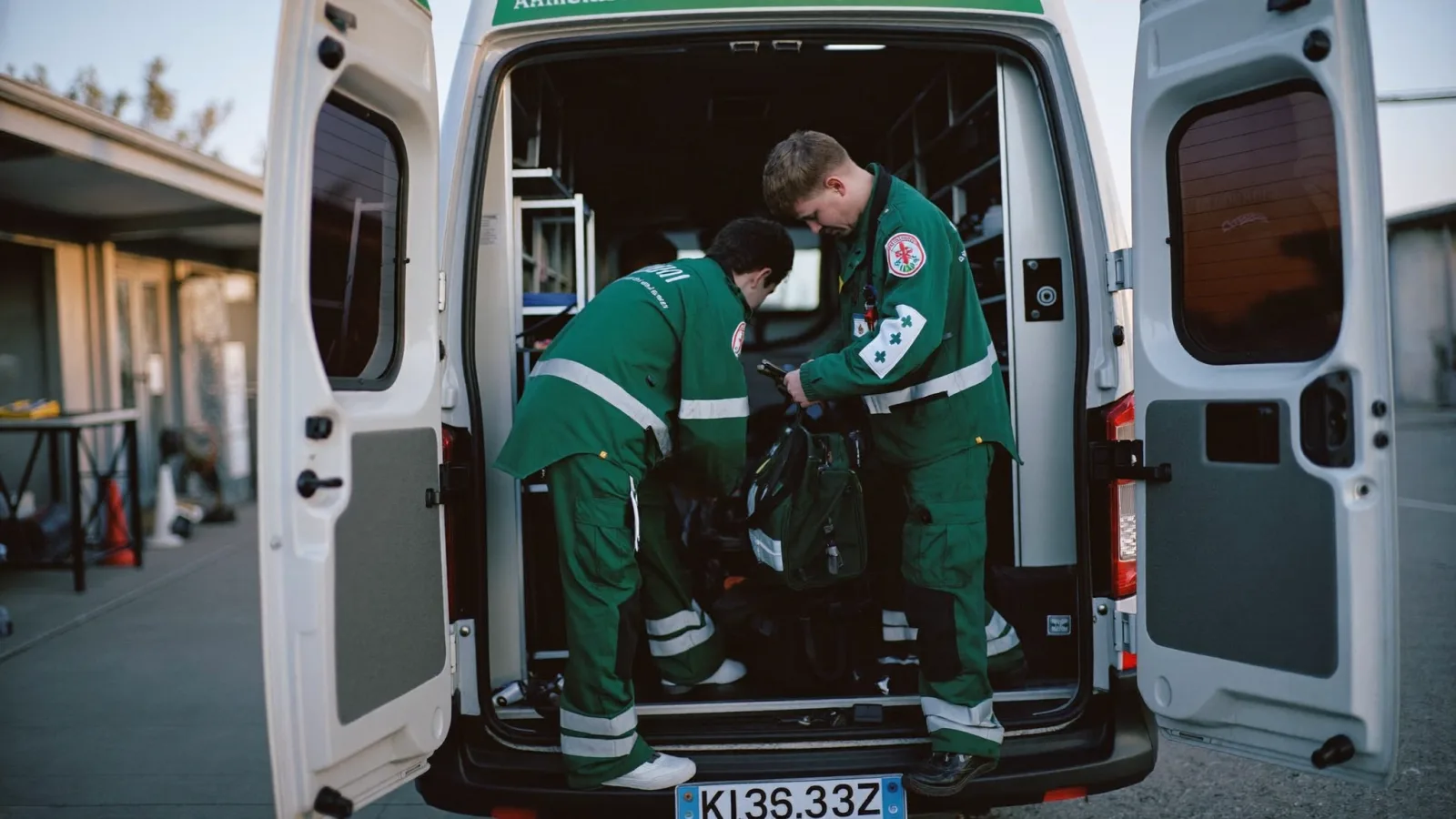
Tom arrives before six for a shift starting at six, because the vehicle check cannot happen afterwards. He collects the keys, meets his crewmate for the day, and works through the checks: oxygen levels, defibrillator, drugs bag and its seals, suction, response bag, entonox, blue lights, tyres and fuel.
This takes twenty minutes when nothing is missing and longer when something is. It is not a formality. Discovering the equipment gap at three in the morning at a cardiac arrest is the scenario the whole routine exists to prevent.
They are green and available at twenty past six. The first call comes through before they have left the station.
An elderly man, fallen at home overnight, found by a carer in the morning. He has been on the floor for several hours.
This is one of the most common calls in the service, and it is more complex than it sounds. There is the immediate assessment: injuries, whether anything is broken, whether he has been lying long enough for pressure damage or rhabdomyolysis to be a concern, why he fell in the first place. Was it mechanical, or was it a faint, an infection, a cardiac problem, or medication?
Then there is the question that takes longer. Does he need hospital? He does not want to go. He lives alone. His daughter is two hours away. The carer comes twice a day. If he stays, who checks on him tonight?
Tom spends forty minutes on this, most of it not clinical: observations and an ECG, then phone calls to the falls team, to the GP, to the daughter, and a referral to community services. The man stays at home with a plan. On paper it is a job with no conveyance. In practice it was the most skilled decision of the morning.
The calls run without meaningful gaps. Chest pain in a supermarket, which turns out to be musculoskeletal but is worked up fully because you cannot know that from the doorway. A young woman with a mental health crisis, where the ambulance is called because there is nobody else to call and the crew spend an hour and a half finding the right service. A child with a febrile illness whose parents are frightened, where the clinical assessment takes ten minutes and the reassurance takes twenty.
Between jobs, they are often not returned to station. Standby points are on retail park corners and lay-bys. Lunch is when it happens.
Mid-afternoon, a category one call. A cardiac arrest in a house.
The next fifteen minutes are the part of the job people imagine, and they are, briefly, exactly that: compressions, airway, rhythm analysis, drugs, a second crew arriving, a critical care team, the choreography of a resuscitation in a small living room with furniture pushed against the walls and a family in the hallway.
Sometimes it works. Often it does not. Either way there is a period afterwards that television does not show: talking to the family, the paperwork, cleaning and restocking the vehicle, and the drive to the next call, which is dispatched while you are still restocking.
Most services now have some form of post-incident support, and the culture around using it has improved considerably. Whether a given crew feels able to take a breather afterwards varies enormously by service and by management.
Twice today they have waited at the emergency department. Once for twenty minutes, once for considerably longer, standing in a corridor with a patient on the trolley, giving observations at intervals, apologising to someone who is unwell and has now been in a queue for over an hour.
Handover delays are one of the most consistently reported frustrations in the service. They are also clinically significant: a crew waiting is a crew not responding, and everyone in the corridor knows it.
Handover itself is a structured, brief summary to the receiving nurse: what was found, what was done, what changed, what to watch. Getting this right in ninety seconds is a real skill.
Most calls are not emergencies. A substantial proportion of the work is urgent rather than immediately life-threatening, and a good deal of it could have been managed elsewhere if elsewhere had been available.
You are a decision-maker about non-conveyance. Deciding that someone does not need to go to hospital carries real risk and real responsibility, and paramedics now do this constantly. The clinical reasoning involved is considerably more advanced than the job's public image suggests.
You go into people's homes. You see how people actually live, including poverty, hoarding, neglect and isolation. Safeguarding referrals are a routine part of the work.
It is physically hard. Carrying equipment up stairs, moving people in confined spaces, working on floors. Musculoskeletal injury is a leading cause of absence in the service.
The toilet and food situation is genuinely difficult. This sounds trivial and is one of the most common complaints from crews.
A twelve-hour shift ends at six, except when it does not. Late finishes are routine, because a call that comes in at ten to six still has to be completed. Crews frequently finish an hour or more after their shift end, and while there are policies on this, they hold better in some services than others.
Tom restocks, hands over the vehicle, and drives home. He will do this again tomorrow, then have days off, then a run of nights.
Clinical knowledge, obviously, and increasingly a lot of it: paramedic education is now a degree-level profession with registration through the Health and Care Professions Council. But the things that distinguish good paramedics tend to be judgement in ambiguity, the ability to lead in someone else's home with no team and no equipment beyond what you carried in, communication with frightened people, and a fairly robust way of processing what you see.
Paramedic careers have widened enormously. Beyond frontline operations there are specialist paramedic and advanced paramedic roles, critical care and air ambulance, hazardous area response, education, clinical leadership, and control room clinical roles. A large number of paramedics now work in primary care, doing home visits and urgent assessments for GP practices, which offers daytime hours and appeals to people who want to leave shift work but keep the clinical role.
This article is general information, not legal, immigration or medical advice. Always confirm current requirements with the relevant official body.
Where to look next
Keep reading
We would like to set one optional cookie that recognises your browser when you come back, so we can tell returning visitors from new ones. It stays off unless you say yes, and you can change your mind at any time. Cookies that keep you signed in are always on. Read our cookie policy