
Nursing specialties6 min
Children's nursing is a separate field of the register with its own degree. What the work involves, where the jobs are, and what people find hardest about it.
By Aisha Rahman, Staff Writer — Aisha writes about nursing specialties and training routes for Healthcare Job Search.

Children's nursing is a separate field of the nursing register with its own degree, and that structural fact surprises people who assume paediatrics is a specialty you move into after general training. It is not. If you want to nurse children in most settings, you generally need to have trained for it.
Pre-registration nursing in the UK is divided into four fields: adult, mental health, learning disability and children's nursing. You choose at the point of applying to a degree, you train in that field, and you register in it.
The practical consequence is that an adult nurse cannot simply transfer to a children's ward. There are routes across, discussed below, but they involve further education rather than a sideways move. This catches people out, and it is the single most important thing to understand if paediatrics is where you want to end up.
A children's nursing degree. Three years full-time, or a four-year apprenticeship where available. The direct route.
A dual field degree. Some universities offer programmes leading to registration in two fields, most commonly adult and children's, or children's and mental health. These are longer, typically four years, and are competitive, but they produce a genuinely useful dual registration.
A postgraduate programme. For graduates with a relevant first degree, shortened master's-level pre-registration programmes exist in around two years.
A second registration. An already-registered adult nurse can undertake a shortened programme to add children's nursing to their registration. Availability varies considerably by region and by university, and funding is the usual obstacle, since these are not always supported the way an initial programme is.
Working with children without children's registration. There are settings where adult-registered nurses do work with young people, particularly in transition services, some community settings, emergency departments and some specialist areas, subject to local policy and appropriate competencies. This is not a substitute for registration where registration is required, and it varies.
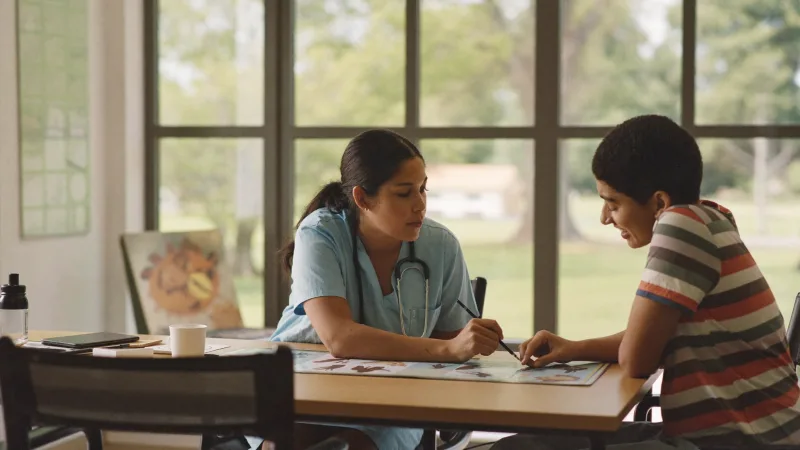
The image is a hospital children's ward, and that is a substantial part of it, but not the whole.
Acute inpatient wards, general paediatrics and specialties including surgery, oncology, cardiology, respiratory and neurology.
Neonatal units, which is a distinct sub-specialty with its own qualifications, caring for premature and sick newborns. Many neonatal nurses are children's nurses; some come from midwifery or adult backgrounds with specific training.
Paediatric intensive care, highly specialist and concentrated in a relatively small number of centres.
Emergency departments, where dedicated paediatric areas and paediatric-trained staff are the expectation.
Community children's nursing, supporting children with long-term conditions, complex needs, technology dependence and palliative care at home. This has grown substantially as more children live with conditions that would once have been fatal.
Children's hospices, which are distinct from adult hospices in that they often support families over many years rather than weeks.
Schools, safeguarding and public health, including school nursing, which has its own specialist community public health qualification.
Child and adolescent mental health services, though mental health registration is the more common route here.
The patient is a family, not an individual. You are caring for a child and simultaneously supporting parents who are frightened, exhausted and sometimes angry. Parents are usually resident, which means you are working continuously in front of them. Nurses moving from adult settings consistently name this as the biggest adjustment.
Assessment is different. Children compensate physiologically and then deteriorate quickly. A child who looks reasonably well can be considerably sicker than they appear, and the recognition skills involved, along with structured tools for identifying deterioration, are central to the role.
Communication is age-specific. You need to be able to explain a procedure to a four-year-old, negotiate with a fourteen-year-old about their treatment, and talk to a parent about a serious diagnosis, sometimes in the same hour. Play is a clinical tool, not a distraction, which is why play specialists are part of the team.
Consent and capacity are complicated. Consent involving children, parental responsibility, competence in young people and the circumstances in which a young person can consent or refuse are genuinely complex areas of law and ethics, and paediatric nurses deal with them regularly.
Safeguarding is constant. Children's nurses carry a high level of safeguarding responsibility, and recognising and acting on concerns is part of the everyday job rather than an occasional event.
The medication maths matters more. Almost everything is weight-based. Drug calculation errors have a narrower margin in a small child, and the checking culture reflects that.
Nobody in paediatrics pretends this is easy. Seriously ill and dying children is the part everyone asks about, and it is as difficult as it sounds. Nurses who stay in the field usually describe two things that make it sustainable: the team, which tends to be unusually close, and the fact that most children get better, which is genuinely true and is easy to lose sight of from outside.
Safeguarding work is the other weight. Being involved in cases of abuse and neglect, and sometimes in court proceedings, is a cumulative burden that services vary in how well they support.
Ask about clinical supervision, debriefs and psychological support at interview. In paediatrics these are not perks.
Children recover fast and visibly. Play as part of the job. Working with families over long periods in chronic conditions and building real relationships. And a working culture that is, by broad consensus among people who have worked in both, warmer than most adult settings.
Progression runs through senior staff nurse and ward manager roles into matron and service leadership, and into specialist practice: paediatric oncology, neonatal, intensive care, respiratory, diabetes, epilepsy, safeguarding, and clinical nurse specialist roles across most conditions.
Advanced clinical practice in paediatrics is well established, particularly in emergency and acute paediatrics. There are also strong routes into community children's nursing, school nursing, health visiting, education and research.
Demand is generally steady, with particular pressure in neonatal, intensive care and community children's nursing, and specialist qualifications in these areas are well rewarded in terms of opportunity.
If you are applying to a nursing degree and think you want to work with children, choose the children's field or a dual programme. Do not choose adult on the assumption you can move later. It is possible, but it is a further programme, and the funding and availability are not guaranteed.
For the standards, fields of practice and programme requirements, the NMC publishes the definitive guidance, and individual universities set out their own entry requirements and available routes.
This article is general information, not legal, immigration or medical advice. Always confirm current requirements with the relevant official body.
Where to look next
Keep reading
We would like to set one optional cookie that recognises your browser when you come back, so we can tell returning visitors from new ones. It stays off unless you say yes, and you can change your mind at any time. Cookies that keep you signed in are always on. Read our cookie policy