
Career explainer6 min
ODPs work in anaesthetics, surgery and recovery, and the profession is chronically short of people. What the role covers and how the degree route works.
By Priya Chandran, Staff Writer — Priya writes career explainers covering the full range of UK healthcare professions for Healthcare Job Search.
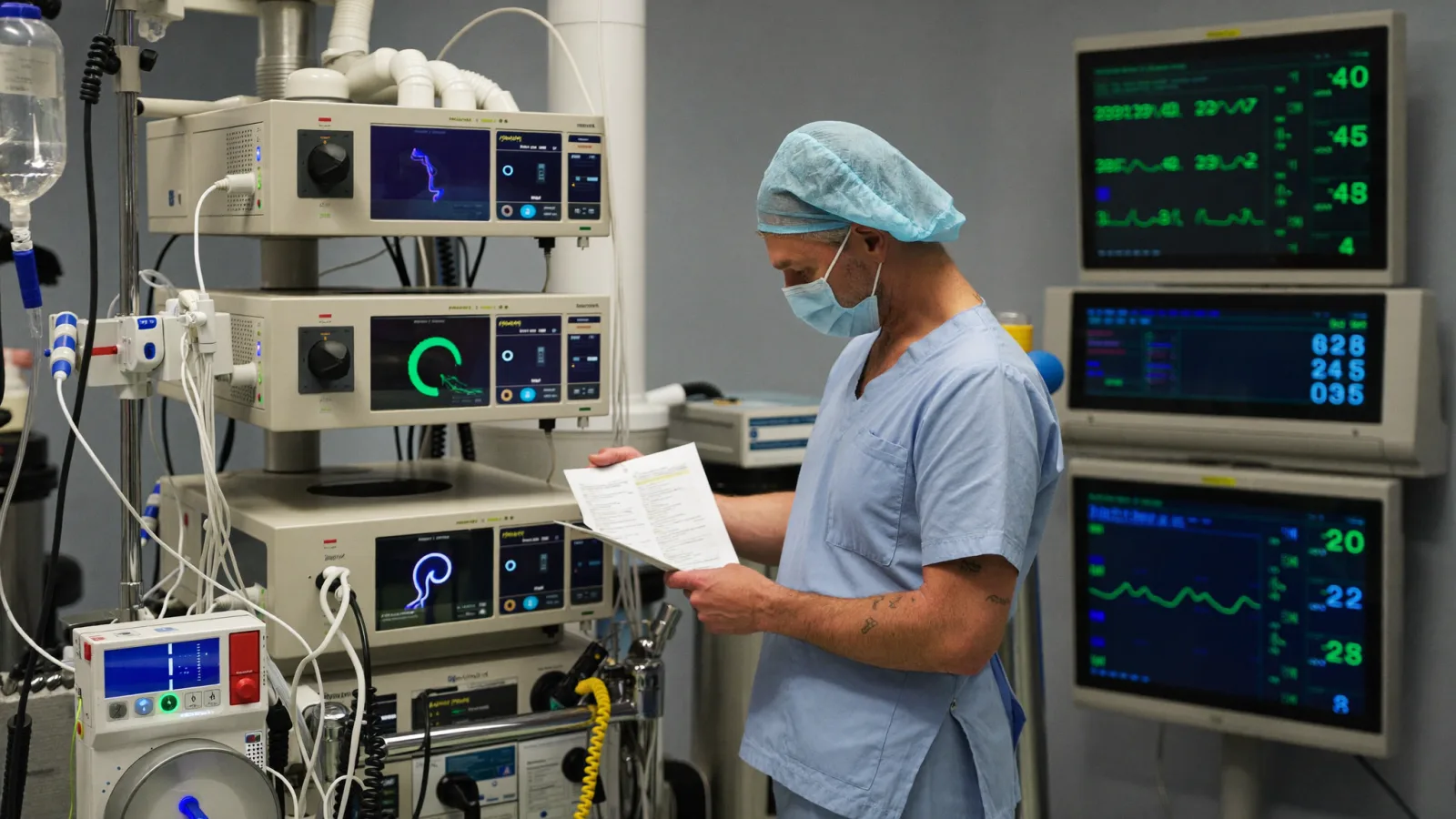
Operating department practitioners are among the most consistently short-staffed professions in the NHS and among the least known outside hospitals. If you have never heard of the role, that is not unusual; if you are looking for a clinical career with a direct three-year route in and reliable demand at the end, it is worth knowing about.
Operating department practitioners work across the whole perioperative journey, and their training covers three distinct phases of it.
Anaesthetics. Preparing the anaesthetic room and equipment, checking drugs and airway equipment, assisting the anaesthetist during induction, managing the airway trolley, monitoring the patient, and being the second pair of trained hands in an emergency. This is the phase most closely associated with the profession.
Surgery. Scrubbing for procedures, managing the sterile field, preparing and passing instruments, and being accountable for the swab, needle and instrument count. ODPs and theatre nurses do this work alongside each other.
Recovery, or post-anaesthetic care. Receiving patients as they emerge from anaesthesia, managing airway, pain, nausea and cardiovascular stability, recognising and acting on complications, and deciding when someone is fit to return to a ward.
Beyond theatres, ODPs work in emergency departments, intensive care, obstetric theatres, interventional radiology, endoscopy, pain services, resuscitation teams and transfer teams. The airway and resuscitation skills transfer widely.
The qualification is a three-year BSc in operating department practice, approved by the Health and Care Professions Council. On completion you register with the HCPC, and the title operating department practitioner is protected in law.
Programmes combine university study with substantial clinical placement in theatres and related settings from early in the course. Because the placement content is so specific, students spend a large proportion of their time in the environment they will work in, which is one reason the transition to qualified practice is generally smoother than in some professions.
Degree apprenticeship routes exist in some areas, allowing people already working in theatres, often as theatre support workers, to qualify while employed. Availability depends on employer funding.
Entry requirements are set by universities and are generally comparable to other health degrees. Access to Higher Education diplomas and level 3 vocational qualifications are widely accepted.
This is the question most people arrive with, and the honest answer is that in scrub and anaesthetic roles the two work largely interchangeably in most departments, with local variation.
The differences that matter practically:
Route in. ODP is a direct three-year degree specifically for this environment. Theatre nursing requires a nursing degree, which is broader and can be used across the whole of nursing, followed by moving into theatres afterwards.
Breadth of career. A nursing registration is portable across every setting nursing exists in. An ODP registration is focused on the perioperative and related environments, which is narrower, though wider than people assume.
Depth of preparation. ODP training is entirely oriented to this work from day one, so newly qualified ODPs typically arrive more immediately competent in theatres than newly qualified nurses moving in later.
Anaesthetic practice. ODPs are trained in anaesthetic assistance throughout their programme; nurses generally acquire it afterwards through in-house competency frameworks.
If you are certain that theatres is where you want to be, the ODP route is the more direct and more targeted path. If you want to keep options open across healthcare, nursing is broader.
Structured around lists. Theatre days follow a planned sequence of cases, with a team brief at the start and safety checks before each patient. Compared with ward or emergency work, the day has a shape.
Intense but bounded. Cases have a beginning and an end. There is no caseload following you home in the way there is in community or ward work.
Physically demanding. Long periods standing, sometimes in one position, sometimes in lead aprons. Manual handling of anaesthetised patients. Musculoskeletal issues are common.
Team-dependent. You work with the same surgeons, anaesthetists and colleagues repeatedly, and the quality of the department's culture affects the job more than almost anything else.
On-call is normal. Emergency theatre work happens overnight and at weekends, and most departments run an on-call rota. This is a significant lifestyle consideration and should be asked about specifically.
Patient contact is brief and matters. You meet people at a moment of real fear, for a few minutes, and then they are unconscious and entirely dependent on the team. ODPs generally describe advocacy for the unconscious patient as the core of what they do.
A combination of low public awareness, a limited number of training programmes relative to demand, competition from the independent sector, and rising elective activity following pandemic backlogs, which requires theatre capacity that requires staff.
Reports on the theatre workforce have repeatedly identified ODPs and theatre practitioners as a constraint on how much surgery can actually be delivered. For a jobseeker, that translates into reliable demand, and it is common for newly qualified ODPs to have several options.
ODPs in the NHS are employed on Agenda for Change terms, typically entering at Band 5 with progression to Band 6 in senior and specialist roles and higher for team leadership and management.
Progression routes include specialist practice in particular surgical specialties, surgical first assistant roles, advanced practice in perioperative or critical care, resuscitation and transfer roles, theatre coordination and management, education and practice development.
There is also strong demand in the independent sector, which does a great deal of elective surgery and often offers daytime work with less emergency on-call, and agency work is readily available for those who want it.
It suits people who like technical precision, who work well in a defined team under pressure, who want a direct route into a clinical profession, and who are comfortable with care that is largely delivered to unconscious patients.
It suits less well people who came to healthcare primarily for relationships with patients over time, or who dislike the confinement of working in one department.
For the standards and registration requirements, the HCPC publishes the definitive guidance, and the College of Operating Department Practitioners is the professional body for the role.
This article is general information, not legal, immigration or medical advice. Always confirm current requirements with the relevant official body.
Where to look next
Keep reading


We would like to set one optional cookie that recognises your browser when you come back, so we can tell returning visitors from new ones. It stays off unless you say yes, and you can change your mind at any time. Cookies that keep you signed in are always on. Read our cookie policy