Work-life & shifts8 min
Nights pay more and suit some people well, but the body does not adapt on its own. Practical, evidence-informed ways to protect sleep, health and safety.
By Sam Whitfield, Staff Writer — Sam writes about flexible working and pay models in healthcare for Healthcare Job Search.
Night shifts are unavoidable in most clinical careers, and for many people they are actively chosen: the pay is better, the work is often calmer, and a compressed run of nights can leave long stretches free. What they are not is neutral. The body does not adapt to permanent night working the way people hope, and the difference between managing nights well and badly is largely a matter of habits that can be learned.
Your circadian rhythm is set primarily by light exposure, and it governs far more than sleepiness: body temperature, hormone release, digestion and alertness all follow it. Working nights asks you to be alert when that system is set to sleep, and to sleep when it is set to wake.
Most people never fully shift. Even long-term night workers usually retain a substantially day-oriented rhythm, because they revert on days off. This is why the most difficult shifts are typically the first night of a run and the small hours of any night, and why the drive home after a night shift is one of the genuinely dangerous parts of the job.
The associations found in research on long-term shift work include disrupted sleep, gastrointestinal problems, metabolic effects, and cardiovascular risk. None of this means nights are impossible or that you should avoid them, but it does justify treating recovery as part of the job rather than an afterthought.
Do not start sleep-deprived. The most useful single intervention is a nap on the afternoon before your first night, ideally an hour or two. People skip it because they do not feel tired at three in the afternoon; take it anyway, in a dark room. It substantially reduces how bad the first night feels.
Shift your sleep slightly. Going to bed later and getting up later in the day or two before helps, though it is not always practical with family commitments.
Sort out the practical things first. Food shopping, the tank of fuel, the childcare arrangements. Decisions are worse when you are tired, and errands after a night shift are how people end up not sleeping.
Use light deliberately. Bright light during the first part of the shift helps alertness. If your unit is dimly lit at night, getting into a brighter area for a while helps.
Time caffeine. Caffeine works, and it works best used tactically rather than continuously. A dose early in the shift is useful; a dose in the last few hours will still be in your system when you are trying to sleep. Its half-life means a coffee at four in the morning is meaningfully present at lunchtime.
Eat like it is a working day, not a night out. The instinct is to graze on whatever is in the staff room. Digestion is impaired overnight, and heavy or sugary food produces exactly the slump you are trying to avoid. A proper meal before or early in the shift, then something light, works better for most people. Take food in rather than relying on what is available at three in the morning, because usually nothing is.
Take your break, and take it properly. Legal rest break entitlements apply. Where a facility exists and local policy permits, a short nap during a night break is supported by evidence and is increasingly encouraged rather than frowned upon; twenty to thirty minutes avoids waking from deep sleep. If your organisation has no policy on this, it is a reasonable thing to raise.
Move. Sitting still at three in the morning is when alertness falls apart. Even brief activity helps.
This is the part to take most seriously. Driving after a night shift is a well-recognised hazard, and drowsy driving impairs performance in ways comparable to alcohol. Falling asleep at the wheel on the way home is not rare among healthcare staff.
Practical mitigations: wear sunglasses on the way home, both to protect your sleep and because glare worsens fatigue; keep the journey short if you can choose where you work; consider public transport or a lift; and if you feel genuinely unsafe, pull over and sleep, or ask whether you can rest at work before setting off. Many organisations will let you, and none of them want the alternative.
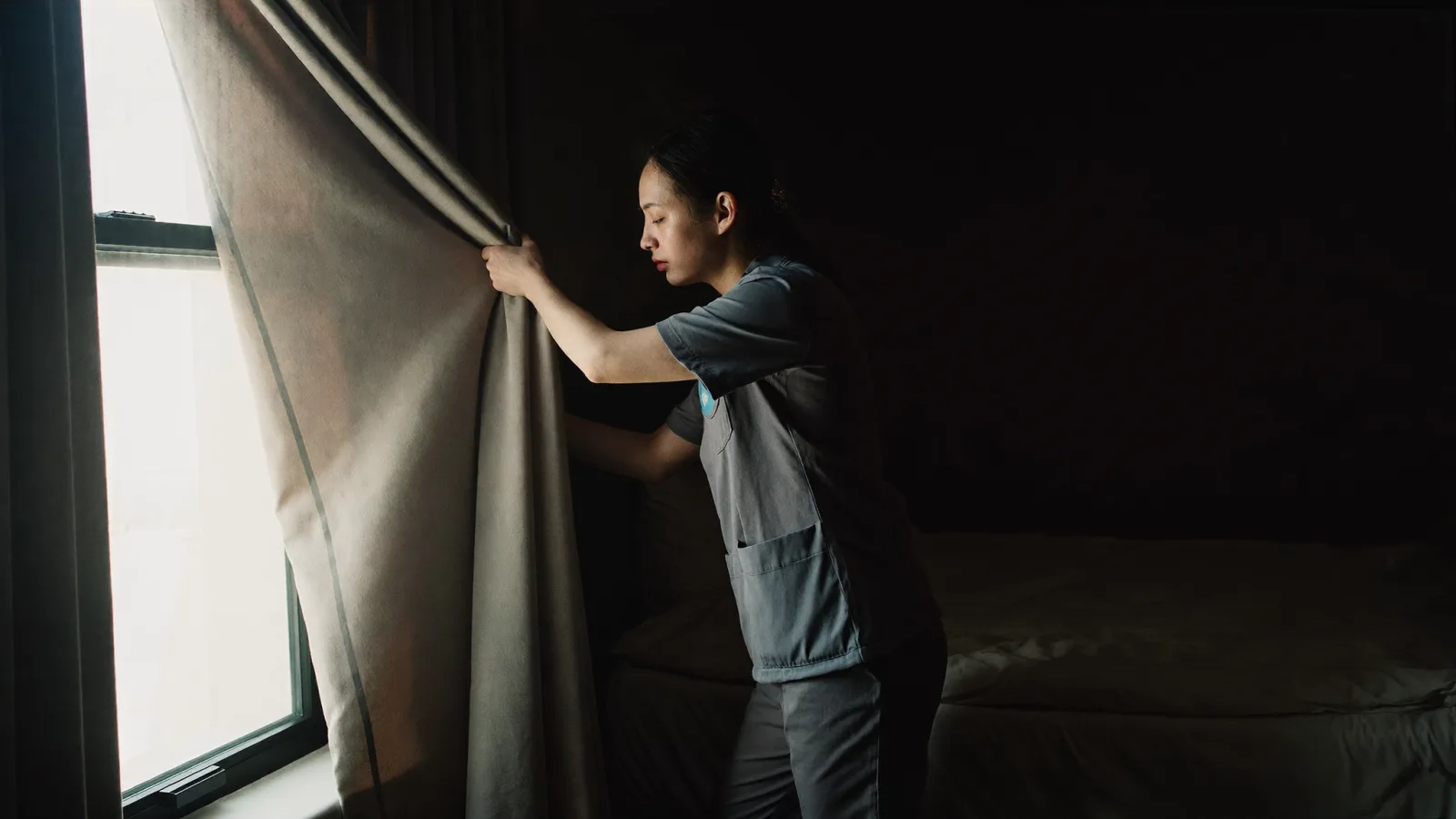
Make the room properly dark. Blackout blinds or curtains, and covering light sources. Light leakage is the main reason day sleep is shallow.
Deal with noise. Earplugs, white noise, phone on silent with an exception for genuine emergencies. Tell the household, and tell them specifically what "asleep" means rather than assuming they will infer it.
Keep it cool. Body temperature needs to fall for good sleep, and daytime bedrooms are usually warmer than night-time ones.
Choose one sleep pattern and be consistent. Broadly, people either sleep straight after the shift for a long block, or split it into a shorter sleep in the morning and a nap before the next shift. Both work. Alternating between them at random does not.
Do not use alcohol as a sleep aid. It shortens sleep latency and then fragments the second half of your sleep, which is the opposite of what you need.
The last night is not the end of the run; the recovery is. The approach most people find works is to sleep for a limited period after the final shift, perhaps three or four hours, get up in the afternoon, get outside into daylight, stay up until a normal bedtime, and accept that the first night back on a normal schedule will be long.
Sleeping the entire day after your last night feels wonderful and costs you the following night, which is why some people never feel recovered before the next run.
Give yourself more recovery time than you think you need when planning anything significant after a run of nights. Driving long distances, making important decisions or attending things that matter are all better placed a day later.
Rotating patterns are generally harder than fixed ones, because you never settle. Forward rotation, moving days to evenings to nights, is usually easier than the reverse.
Nights get harder with age for most people, and there is nothing wrong with acknowledging that. Flexible working requests are available and healthcare employers are increasingly used to them.
Talk to occupational health if nights are affecting your health, particularly if you have a condition that interacts with them such as diabetes, epilepsy or a mental health condition. Adjustments are possible and this is precisely what the service is for.
Watch for the signs that it is not working: persistent daytime sleepiness on days off, relying on alcohol or sedatives to sleep, falling asleep driving, mood changes, or repeated near misses at work. These are reasons to seek advice rather than push on.
Nights suit some people genuinely well, and there are clinicians who prefer them for decades. The ones who do well are almost always the ones who protect their sleep deliberately rather than hoping to get away with it.
For guidance on shift working and health, the Health and Safety Executive publishes material on managing shift work risks, and your occupational health service can advise on your individual circumstances.
This guide is general information, not legal, immigration or medical advice. Always confirm current requirements with the relevant official body.
Where to look next
Last reviewed 5 September 2026.
Keep reading
We would like to set one optional cookie that recognises your browser when you come back, so we can tell returning visitors from new ones. It stays off unless you say yes, and you can change your mind at any time. Cookies that keep you signed in are always on. Read our cookie policy