

Applications7 min
The NHS mostly uses structured application forms, private and care providers often want a CV. Knowing which you are facing changes how you should write.
By Priya Chandran, Careers Editor — Priya writes about NHS careers and recruitment for Healthcare Job Search.
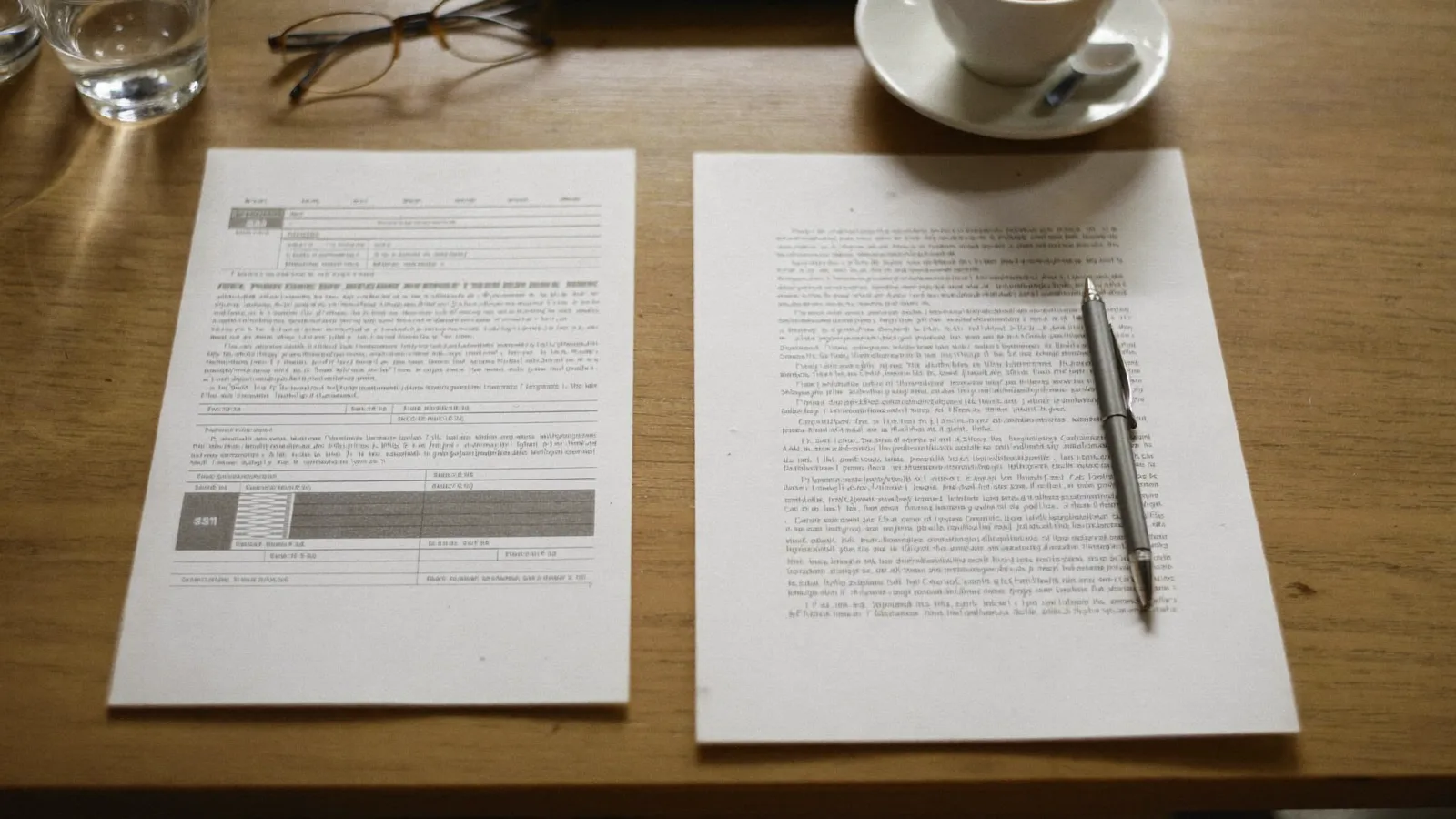
One of the quieter reasons good candidates get rejected in health and social care is that they wrote the wrong kind of document. A CV and a structured application form are not two formats for the same information. They are assessed differently, by different people, against different things, and writing for one when you are facing the other rarely works.
Most NHS vacancies are handled through a structured application form. The reason is fairness rather than bureaucracy. A form presents every candidate's information in the same order, in the same fields, with the same prompts, which makes it far easier to shortlist consistently against a person specification and much harder for irrelevant factors to influence a decision. It also lets the employer separate monitoring information, such as ethnicity or date of birth, from the material the panel actually sees.
The practical consequence is that the form controls what you can say and where you can say it. Your employment history goes in the employment history fields, whether or not you think a particular job is interesting. Your qualifications go in the qualifications fields. There is usually no scope to reorder anything, lead with your strengths, or design the reading experience. Almost all of your influence sits in one free-text box, generally called supporting information or personal statement.
Private hospital groups, care home operators, hospices, GP practices, agencies and smaller charities are much more likely to ask for a CV, often with a short covering letter or email. They are usually recruiting at lower volume, without a central recruitment system, and frequently with the recruiting manager doing the reading themselves.
A CV gives you control that a form does not. You choose the order, the emphasis, the length and what to leave out. That freedom is genuinely useful, but it also means the burden of making your case readable falls entirely on you. Nobody has laid out the criteria for you in the document itself.
The difference is not tone or vocabulary. It is structure and the assumptions you can make about your reader.
On a form, write to the specification. The panel is very likely working through the person specification criterion by criterion, ticking off whether the evidence is there. So structure your supporting information in roughly the order the specification lists its essential criteria, and make it obvious which paragraph addresses which. Some candidates use short subheadings that echo the criteria. Panels rarely object, because it makes their job easier. Do not assume the reader will hunt for evidence, or infer that because you worked somewhere for four years you must have done a particular thing. If a criterion asks for experience of something, say plainly that you have it and give an example.
On a CV, write to be skimmed. Nobody is ticking boxes on your behalf, and the document may get ninety seconds. The most relevant things need to be visible near the top: a specific profile, your registration status, your current role and setting. Detail is earned by relevance, not by chronology, so your most recent and most applicable roles get the bullets and older ones get a line each.
Duplication reads differently. On a form, repeating a point under two different criteria is normal and expected, because each criterion is scored separately. On a CV, repetition reads as padding.
Length works in opposite directions. Forms usually impose a word or character limit on supporting information, and the discipline is to fit everything essential inside it. CVs have no stated limit, and the discipline is to stop at two pages when you could easily write four.
Covering letters belong with CVs, not with forms. If you are sending a CV to a care provider or a private hospital, a short letter or a well-written email body doing the same job is worth including even when it is not requested. Keep it to a few paragraphs: what you are applying for, why this employer and this role specifically, and the two or three things about you that most directly match what they asked for.
If you are completing a form, do not attach a covering letter as a substitute for filling in the supporting information box. Attachments are frequently not circulated to panels at all.
Some employers, particularly larger private groups and some hospices, ask for a CV and then require a form later, or ask you to complete a short form and attach a CV. Where both exist, treat the form as the document that will be assessed and the CV as supporting context. Make sure they do not contradict each other on dates, job titles or reasons for leaving, because discrepancies have to be resolved before an offer can be confirmed and that costs time.
You do not need to start from nothing each time. What is worth building once and keeping is a personal evidence bank: a plain document listing your employment history with exact dates, your qualifications and dates, your registration details, your competencies, your mandatory training, your referees, and a set of written examples of things you have done, each covering the situation, what you did and what happened.
From that bank, a form becomes an exercise in selecting and reshaping examples against the criteria, and a CV becomes an exercise in selecting and ordering. Both get considerably faster, and both stay specific, which is the thing that actually distinguishes applications.
The underlying point is the same in both cases. The employer has written down what they need, in the person specification, and the application that gets shortlisted is the one that makes it easy to see you have it. The format only changes how you go about showing that.
For the criteria attached to any specific post, work from the job description and person specification published with that advert.
This guide is general information, not legal, immigration or medical advice. Always confirm current requirements with the relevant official body.
Where to look next
Last reviewed 19 August 2026.
Keep reading


We would like to set one optional cookie that recognises your browser when you come back, so we can tell returning visitors from new ones. It stays off unless you say yes, and you can change your mind at any time. Cookies that keep you signed in are always on. Read our cookie policy